Workers’ Compensation Insurance
Get Workers’ Comp insurance to protect employees and your business
Choose your primary industry to get started:




What is Workers’ Compensation insurance?
What does Workers’ Comp insurance cover?
- Medical expenses
- Lost wages
- Job retraining
- Permanent injury benefits
- Employers liability
- Survivor benefits and death benefits
What does Workers’ Compensation cost?
Starting at $14/month†
Buy online in about 10 minutes, and cancel anytime.
Who needs Workers’ Comp policies most?
- Business owners with employees
- Self-employed business owners
- Business owners in states that require coverage
- Business owners in industries that require coverage
Workers’ Compensation insurance for small businesses can help cover workplace illness and injury costs

Medical expenses for employees who get hurt on the job
Including examinations, treatments and rehabilitation.** Business owners can opt to add themselves to coverage.

Lost wages during recovery
Employees still have bills to pay while they recover from a work-related illness or injury. A workers’ comp insurance policy could help.

Job retraining for sustained injuries
Some employees may need to learn skills or enter a new field during recovery, and a workers’ comp policy could help with the cost.

Permanent injury or disability coverage
In the case of severe work injuries, workers’ compensation coverage could provide benefits for employees who can no longer work.

Death and survivor benefits
In the event of life-ending illness or injury on the job, workers’ comp coverage can help support families with funeral costs and income replacement.

Employers liability legal protection
In addition to covering costs for employees, business owners could get assistance if an employee files a lawsuit for negligence.

How much does Workers’ Comp insurance cost?
Workers compensation insurance policies can cost as little as $14/month† for some low-risk businesses.
Several factors influence the price you’ll pay for insurance, including:
- Your industry
- Your number of employees
- The size of your business
- Where you do business
- Your business needs and how much coverage you choose
- Policy limits
How to get a Workers’ Comp insurance quote online
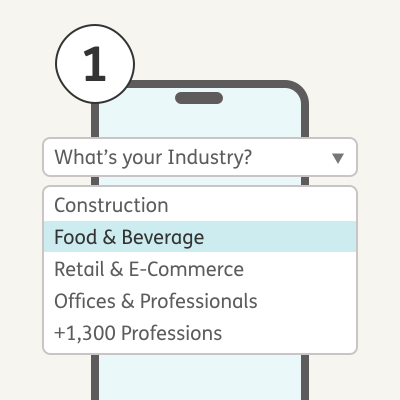
Answer a few questions
In about 10 minutes you’ll see your exact workers’ compensation insurance cost.
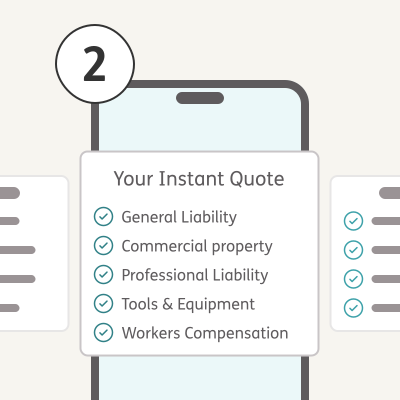
Customize your coverage
Adjust your policy limits and deductibles to pick the right coverage at the right price.
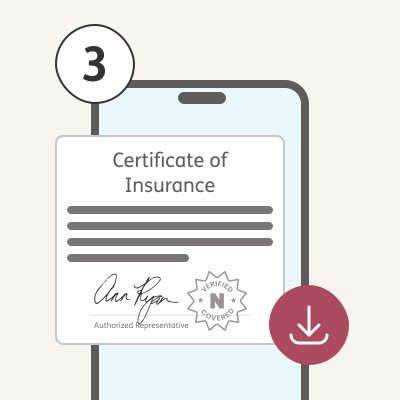
Buy 100% online
Your coverage is effective the next day after payment. And you can share unlimited certificates of insurance at no extra cost.
Who needs Workers’ Comp insurance coverage?

Restaurants and food service
If your employee slips on a wet floor and requires a visit to the emergency room, a dull knife causes your line cook to get stitches, or a flare up causes an accidental burn, workers’ compensation insurance coverage for your food business could help cover medical bills and recovery costs.**

Construction trades
Construction jobs and contracting work like electricians, plumbers, carpenters, painters and more can be very physical, meaning workplace injuries such as repetitive stress trauma and injuries from tools and machinery can be common. If you or your employee gets hurt, medical bills could add up quickly. Workers’ comp for contractors and construction could help.

Retail and e-commerce
Lifting heavy boxes and bags, loading and unloading inventory, and working with box cutters could all lead to back injuries, repetitive stress issues and stitches. Whether your employees work from home or you own your own physical retail store, a workers’ compensation policy for retail and e-commerce may be required, and it may help protect your business from financial loss.

Cleaners, house cleaning and janitorial
If you’re in the business of cleaning homes or offices, or you do more specialized cleaning such as pressure washing, window washing or carpet cleaning, workers’ compensation coverage for cleaners can help to shield your business from the medical and recovery costs of your employees after chemical burns, back injuries or joint strain while working.
Workers’ Compensation insurance cost calculator
See an estimate for your profession, then get a detailed quote to see the exact price for your business
Where is your business located?


What do you do?
Businesses like yours typically pay:





Workers’ Compensation insurance FAQ (frequently asked questions)
Is Workers’ Comp insurance legally required?
Business owners in most states are legally required to have workers’ compensation coverage if they have employees. Workers’ comp may also be required to get a professional license.
Workers’ compensation insurance coverage requirements are not federal; each state’s workers’ comp agency or board decides its own rules around who must carry coverage, which employees are covered, and the benefits and penalties for non-compliance.
Colorado and Idaho, for example, require business owners to carry a workers’ comp insurance policy after they hire just one employee. Alabama and Mississippi require it for businesses with five or more employees. Some states require coverage based on your annual payroll, such as Kansas who requires this business insurance once your gross annual payroll exceeds $20,000.
Texas is unique because it allows most private employers to opt out of workers’ compensation insurance entirely, though uninsured employers lose certain legal defenses if a worker sues them. South Dakota doesn't mandate it at all but recommends it.
Even when a workers’ compensation policy is not required, many business owners buy coverage for financial protection if an employee experiences a work-related injury or illness. Workers’ comp can also help protect business owners themselves if they add business owner’s coverage to their policy.
Read more about the workers’ compensation insurance laws in every state.
What could happen if you don’t have a Workers’ Comp insurance policy?
In some industries, workers’ compensation can be required to get a professional license or win a contract. For example, general contractors may need to show proof of workers’ comp insurance before bidding on jobs or applying for a business license.
One of the biggest risks of not having workers’ compensation coverage is the financial burden of workplace injuries for employers. If an employee suffers an on-the-job injury, the business owner could be on the hook for medical expenses, lost wages, legal fees and other related costs. And if your employee sues you, you could be paying for legal costs and settlements, too. A single accident could wipe out your business.
Read more about what could happen if you don’t have workers’ comp for your business.
What’s not covered by Workers’ Compensation insurance?
Workers’ comp insurance for small business owners is usually for protection around employees who suffer a work-related illness or injury. Business owners can opt to add protection for their own injuries to their business policy for the same level of coverage.
But workman’s compensation insurance has exclusions. It’s not designed to cover other forms of business risk, such as injuries to non-employees or liability around damages to other people’s property. For that, you would want to look into general liability insurance.
To protect the property you own for your business, commercial property insurance could help.
Other, more specialized types of business insurance coverage could also help shield your business depending on the work that you do, including commercial auto insurance for business driving, tools and equipment insurance if you travel with gear to work at a client’s site or product liability insurance, an add-on to general liability coverage, to help protect you if your products cause harm to someone else.
I'm the owner of the company. Am I covered by my Workers’ Comp policy if I'm hurt on the job?
Injuries to business owners can be covered by business owners’ coverage for workers’ comp, but it’s an optional add-on to the coverage you buy for your employees.
Read more about online workers’ compensation insurance for owners of the business.
How does Workers’ Compensation insurance work?
Workers’ compensation insurance helps protect employees. It may also help protect your business from paying large out-of-pocket costs for workplace injuries and illness. Employers pay the monthly or annual premium, and in return the insurance company can help cover these costs and mitigate the financial burden on your business. In most states, carrying workman’s comp insurance coverage is a requirement.
Workers’ comp also helps employees. If they’re injured on the job they can focus on their recovery without worrying about the financial implications of their injury and loss of work.
By accepting workers’ comp benefits, injured employees typically waive their right to sue their employer for negligence related to the injury. This legal protection can help safeguard your business from costly and time-consuming lawsuits.
Workers’ comp premiums are tied to payroll. And paying an insurance premium is often more cost-efficient than paying for injured workers or job retraining. For example, a $100,000 salary might cost a few thousand dollars in annual premium. This can be more cost-efficient than hefty medical bills and/or lawsuits that could reach hundreds of thousands or more.
The types of claims on your policy and the compensation for care the injured person can receive vary based on your policy, your location and the nature of the injury. Each state sets its own rules for how much is paid for medical bills based on the type and severity of the injury or illness.
If the injury is bad enough that the employee can’t return to work right away, a loss of income claim could help with wage replacement until they’re able to work.
If an injury is so severe that the employee can’t return to work at all, permanent injury benefits may provide compensation to the employee for the rest of their life.
And worst case scenario: If an employee dies after a work-related illness or injury, the employee’s beneficiaries could receive death benefits to cover some funeral expenses. In addition, the employee’s spouse, children or dependents could receive survivor benefits to help offset the family’s loss of income long-term.
Do I need Workers’ Comp if I’m self-employed?
A common misconception about workers’ comp is that it’s only for businesses that have employees.
In fact, workers’ comp coverage for self-employed workers, sole proprietors and independent contractors can provide financial protection and help meet contract requirements with clients.
If you don’t have workers’ comp and you are injured at work, you also might not be covered by your personal health insurance. It’s important to read your policy documents carefully to make sure you are protected.
Read more about workers’ comp coverage for sole proprietors.
Who is exempt from Workers’ Compensation insurance?
Every state except for Texas requires workers’ comp for employees.
However, each state also typically has a short list for who is exempt from coverage. It’s important to check the insurance requirements where you work.
Some states don’t require the insurance for certain types of workers, such as:
-
Agricultural employees
-
Domestic workers
-
Real estate employees
-
Coaches for children’s sports team
Be sure to check the exemptions in your state.
Do business owners without employees need to buy Workers’ Compensation coverage?
If you’re a business owner without employees, you may not be required by law to have workers’ compensation, particularly if you’re a sole proprietor, partner or LLC member.
However, that might not be the case for more regulated industries, such as construction.
Even if it’s not legally required, you could still be asked by your clients for proof of insurance. A certificate of insurance for workers’ comp lets clients know you have coverage if you get injured while working for them.
Do contractors need Workers’ Compensation policy for themselves?
If you’re a sole proprietor or independent contractor without any employees, you usually aren’t required by law to get workers’ comp.
However, the construction industry is often regulated differently and you might be required to have coverage before you take a job.
Regardless if it’s required by law, it can be a good idea to have an active workman’s comp policy. If you get sick or injured on the job, workers’ comp can help cover medical bills and some of your lost wages.
If you’re a sole proprietor or independent contractor with employees, you may need to get workers’ compensation for them.
Workman’s Compensation insurance and Workers’ Compensation insurance: Are they the same?
“Workman’s comp” and “workers’ comp” are exactly the same insurance coverage.
Remember when “fireman” became “firefighter” and “stewardess” became “flight attendant”? The shift from workman’s comp” to workers’ comp follows the same path. It’s part of a broader move toward inclusive language representing all workers, regardless of gender.
While you might still hear some people say workman’s comp insurance, workers’ comp is the current, more inclusive term for this coverage.
Does Workers’ Compensation insurance cover business interruption?
Workers’ compensation does not cover business interruption.
Business income interruption is a type of property insurance that covers the loss of income that a business suffers after an unexpected event, such as a fire or snow storm. It’s included in ERGO NEXT’s commercial property insurance coverage.
Does Workers’ Compensation cover subcontractors?
Workers’ compensation policies generally do not cover subcontractors because they’re not your employees.
However, in some states for some industries, subcontractors may be classified as your employees if they don't carry their own workers compensation. In that case, you must report their payroll as your employees.
What’s the difference between Workers’ Compensation and disability insurance?
Workers’ comp benefits are separate and distinct from disability benefits.
If a work injury results in a permanent injury that renders an employee unable to return to work, workers’ comp can pay some permanent injury benefits, but it varies by state.
A workers’ compensation doctor must verify and rate your disability, and verify that your disability was caused by work.
Is Workers’ Compensation different from health insurance?
Workers’ comp can help with medical expenses and lost wages after an accident or illness on the job.
Health insurance usually covers personal injuries and ailments that happen outside of work.
Learn more about the differences between workers’ comp and health insurance.
When will I get my policy and proof of insurance?
It takes about 10 minutes to get a quote and buy coverage online. Your policy kicks in the next day and you’ll have full access to policy documents and your certificate of insurance (COI) at no extra charge.
You can access your documents and COI 24/7 online or in the ERGO NEXT app for iPhone or Android.
How do I make a Workers’ Compensation insurance claim?
If you’re an ERGO NEXT customer, you can file a claim anytime from your account or in the ERGO NEXT app for iPhone or Android.
If you’re not an ERGO NEXT policy holder and you need to file a claim, please use this form.
Our claims team will ask you to share the details of your work-related illness or injury and to provide relevant photos and documentation.
We strive to make claims decisions as quickly as possible so that you can get back to work.
Read more about filing a workers’ compensation claim with ERGO NEXT.
Get customized insurance wherever you do business
Learn more about workers’ compensation insurance options in the state where you work.
ERGO NEXT Insurance reviews



There’s a lot to love about ERGO NEXT

Get insurance in less than 10 minutes and you can save up to 25% in discounts*

Unique, flexible coverage with easy monthly payments

Do it all 100% online or talk to a licensed U.S.-based advisor
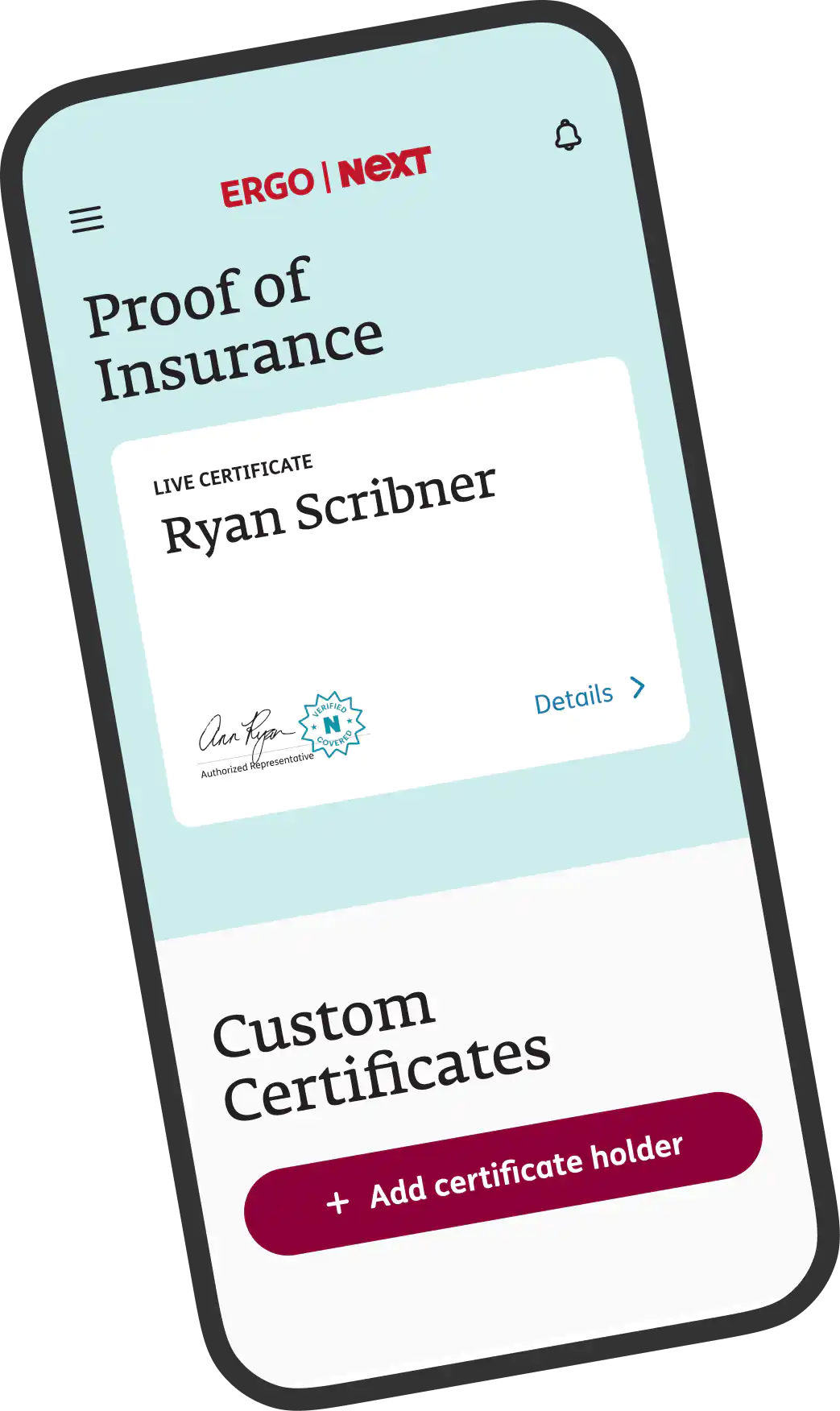
Coverage on-the-go for policyholders
Manage your policies, send and create certificates of insurance, or file a claim with our app.