Workers’ Compensation insurance for restaurants

Save up to 50% on restaurant Workers’ Compensation.*

How can Workers’ Compensation insurance for restaurants help protect your business?

Restaurant workers’ compensation coverage could help cover the costs of:

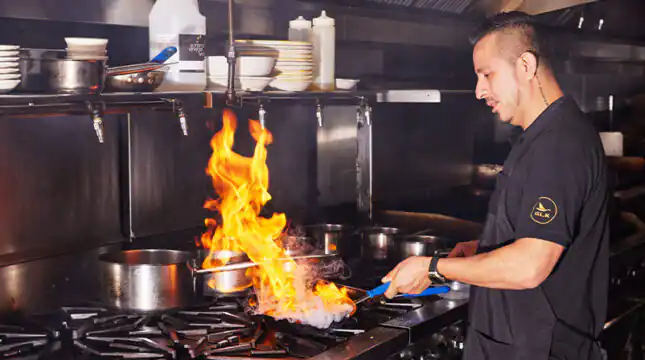
Whether you own a fine dining establishment, catering business, franchise, fast food restaurant or serve out of a food truck, business owners know how physically demanding and potentially dangerous the work can be. In 2024, food service and beverage businesses experienced 2.4 injuries per 100 full-time workers, according to the BLS Survey of Occupational Injuries and Illnesses. For your staff and your bottom line, the risk of hot ovens, slippery floors and sharp tools is all too real.

Workers’ compensation insurance could help protect restaurant owners from financial losses after employee workplace injuries or illness.

And if you run your own restaurant or food business, you can add optional business owner’s coverage for yourself so that you have the same coverage as your employees if you get injured at work.

1. Workers’ Comp may be required by state law

In most states, workers’ compensation insurance is legally required if you have employees. Requirements vary by state: Some require coverage with just one employee, others set the threshold at three or more. Part-time and seasonal employees typically count, which matters for restaurants that bring on extra servers or kitchen staff during busy seasons.

Even if your state doesn’t require workers’ comp coverage, some clients, vendors and event venues will require a certificate of insurance, also called a COI, to prove that you have adequate insurance coverage before they’ll work with you.

2. Workers’ Comp could help cover the cost of work-related injuries

Kitchen and front-of-house work comes with real hazards. A cook who burns their hand, a dishwasher who slips on a wet floor, a delivery driver who strains their back unloading an order — these types of events aren’t rare in the restaurant industry.**

These injuries can lead to an emergency room visit, follow-up medical care and time off to recover. The doctors’ bills and lost wages can add up fast. Workers’ comp could help cover those costs so one bad shift doesn’t threaten your business.

3. Your employee’s income (and your cash flow) could be protected under Workers’ Comp

If an injured employee needs time away to recover, workers’ comp could replace a portion of their lost wages while they heal. For a restaurant worker like a line cook or a server who can’t work a shift, that income protection can make a real difference. And it means you’re not forced to choose between taking care of your staff and protecting your cash flow.

4. A Workers’ Comp policy could help you gain more business

If you run a catering business or food truck, many event venues, corporate clients and general contractors require proof of workers’ comp coverage before they’ll book you — regardless of state law. Even for brick-and-mortar restaurants, some vendors and licensing boards expect you to have business insurance. Carrying coverage signals that you run a professional operation, and having your certificate of insurance (COI) ready to go could help you be more competitive.
What could restaurant Workers’ Comp insurance cover?

These are some of the common risks that you and your team could be exposed to at work:

1. Accidental employee injury costs from falls, burns and cuts

Your employee slips on a wet floor and requires a visit to the emergency room or a knife cut requires stitches in the middle of a shift. Restaurant workers’ compensation insurance could help cover medical bills.

2. Lost wages after an injury or accident

If a kitchen injury keeps one of your employees out of work — a burn needs to heal or a sprain can’t handle a full shift — workers’ comp could help cover a portion of employee wages during recovery. That can mean the difference between financial stability and a real crisis for many employees.

3. Work-related permanent injury or death benefits

Serious injuries are uncommon in food service, but they do happen. If an injury results in long-term disability, workers’ comp could help cover ongoing benefits.

In the event of a workplace fatality, workman’s comp insurance could also help with burial expenses and survivor benefits for the employee’s family.

These aren’t situations any restaurant owner wants to think about, but coverage means you’re prepared for the worst.

4. The costs of an employer liability lawsuit

If an employee believes their injury was caused by unsafe workplace conditions like a broken floor mat or a faulty piece of equipment, they could file a lawsuit against your business. Legal defense costs can be significant, even if the claim isn’t found to be viable. Workers’ comp for restaurants typically includes employer liability coverage that could help cover legal costs and settlements.

What are the most common business risks for restaurants and food businesses?

Working in the food and service industry can expose you to a number of risks. In addition to falls, burns and cuts, some of the most common risks include:

1. Repetitive stress injuries

Restaurant work isn’t just about dramatic accidents. A line cook who chops and preps for eight hours a day, a server who carries heavy trays shift after shift, or a barista who steams hundreds of drinks a week can develop repetitive stress injuries over time — tendinitis, carpal tunnel, back problems. These injuries can build slowly and sideline an employee for weeks or months. Workers’ comp insurance for restaurants could help cover treatment and lost wages for these conditions.

2. Kitchen equipment injuries

In addition to knives, commercial kitchen equipment like slicers and deep fryers can cause serious injury fast. Workers’ comp could help cover the medical costs and recovery time.

3. Heat-related illnesses

Commercial kitchens can get extremely hot, especially during summer service rushes. Heat exhaustion and heat stroke are real occupational hazards for kitchen staff working long shifts in high-temperatures. If a cook collapses during service, workers’ comp could help cover their medical treatment and time off to recover.

4. Injuries during off-site catering or delivery

Catering staff set up and break down events on location, and delivery drivers are exposed to road risks and the physical hazards of loading and unloading. Workers’ comp could help cover employees while working outside the kitchen.

How much does Workers’ Compensation insurance for restaurants cost?

The cost of workers’ compensation insurance (also called the premium) for restaurants and other food service businesses can depend on a number of factors, including:

  • How many employees you have.
  • What type of food service business you operate.
  • Your payroll expenses.
  • How long you’ve been in business.
  • The state where you work.
  • Your claims history.

ERGO NEXT offers tailored, affordable restaurant workers’ comp insurance policies that provide the right coverage for your business

Workers’ Compensation insurance for restaurants FAQ

Get answers to some of the most common questions around restaurant workers compensation coverage.

Is restaurant Workers' Comp insurance required?

In most states, workers' comp insurance for restaurants and other food services businesses is legally required as soon as you hire your first employee. Rules vary by state: Some require coverage when you hire your first employee, others extend to three employees or more.

Part-time and seasonal staff typically count toward that threshold, so if you add servers or kitchen help during a busy season, coverage requirements may apply even if your year-round headcount is small. Check your state's specific rules before your next hire to make sure you’re compliant.

Does Workers' Comp for restaurant workers cover common injuries like burns, cuts and slips?

Even with the best safety training, accidents happen. If a line cook burns their hand and needs urgent care, workers' comp could help cover the medical bills. If a server slips on a wet floor and can't work, workers' comp could help cover a portion of their lost wages. The key is that the injury must be work-related — meaning it happened on the job or as a direct result of your employee's work duties.

Do food trucks and catering businesses need Workers' Comp?

The same state requirements for restaurant workers usually apply to food trucks, caterers and other mobile food businesses. If you have employees, coverage is typically required.

Beyond the legal requirement, many event venues and corporate clients require a certificate of insurance as proof of insurance coverage before they'll work with you — so workers' comp can be a practical business requirement even where it isn't legally mandated.

What if I don't carry Workers' Comp insurance at my restaurant and an employee gets hurt?

If workers' comp is required in your state and you're uninsured, you could be personally responsible for your employee's medical bills and lost wages. Plus you could face state fines, stop-work orders and potential lawsuits. Even where insurance coverage isn't legally required, the out-of-pocket exposure from a single injury can far exceed the cost of a workers’ compensation policy.

How ERGO NEXT can help protect your restaurant or food business

ERGO NEXT has workers’ compensation insurance that’s convenient and affordable – and you can do everything 100% online.

We’ll ask a few questions about your business and give you a quote. You select your coverage options and buy your policy — all in about 10 minutes. Your certificate of insurance will be available immediately, and you can access your policy 24/7 via web or mobile app.

If you have questions, our licensed, U.S.-based insurance professionals are available to help.

Start a free quote with ERGO NEXT.

ERGO NEXT has fast, tailored business insurance for restaurants and food service businesses

Choose your profession to learn more and get a quote

Bakery, Butcher Shop, Catering, Coffee Shop, Farmers Market, Food Cart, Food Truck, Food Vendor, Grocery Store, Personal Chef, Restaurant

ERGO NEXT Insurance reviews

I am so excited
I am totally excited about my new insurance for my small business. I am happy that the price was in a range that I can afford, the terms were easy to understand and it was so simple to purchase my first policy. I look forward to doing business with you in the future.
Curzella J.
Easiest insurance purchase – EVER!
I was looking around trying to compare insurance and I am so lucky I found ERGO NEXT. I was able to compare levels of coverage, and all the options, without pressure from a salesperson or time limits. I was able to check out prices and it was more coverage for less than the “traditional” company I looked at.
Michael W.
Happy small business owner!
I needed liability insurance for my new small business brick & mortar location. I got the run around from another company, but ERGO NEXT provided a competitive insurance quote in a timely manner. I now have the insurance that I need and it was stress-free!
Nicole E.
What we cover
Chat with Us

Mon – Fri | 8 a.m. – 5 p.m. CT

Facebook
Instagram
Tiktok
Twitter
Linkedin
Youtube
© 2026 Next Insurance, Inc. 975 California Ave, Palo Alto, CA 94304, United States
Better Business Bureau
NEXT is part of the ERGO Group, a Munich Re company.

Issuance of coverage is subject to underwriting. Not available in all states. Please see the policy for full terms, conditions and exclusions. Coverage examples are for illustrative purposes only. Your policy documents govern, terms and exclusions apply. Coverage is dependent on actual facts and circumstances giving rise to a claim. Next Insurance, Inc. and/or its affiliates is an insurance agency licensed to sell certain insurance products and may receive compensation from insurance companies for such sales. Policy obligations are the sole responsibility of the issuing insurance company. Refer to Legal Notices section for additional information.

* To the extent permitted by law, applicants are individually underwritten, not all applicants may qualify. Individual rates and savings vary and are subject to change. Discounts and savings are available where state laws and regulations allow, and may vary by state. Certain discounts and policy start times apply to specific coverages only.

** Coverage examples are for illustrative purposes only. Your policy documents govern, terms and exclusions apply. Coverage is dependent on actual facts and circumstances giving rise to a claim.

Any starting prices or premiums represented before an actual customer quote are not guaranteed and are representations of existing premiums of active policies as of March 21, 2025. To the extent permitted by law, applicants are individually underwritten, not all applicants may qualify. Individual rates and savings vary and are subject to change. Discounts and savings are available where state laws and regulations allow, and may vary by state. Certain discounts apply to specific coverages only.