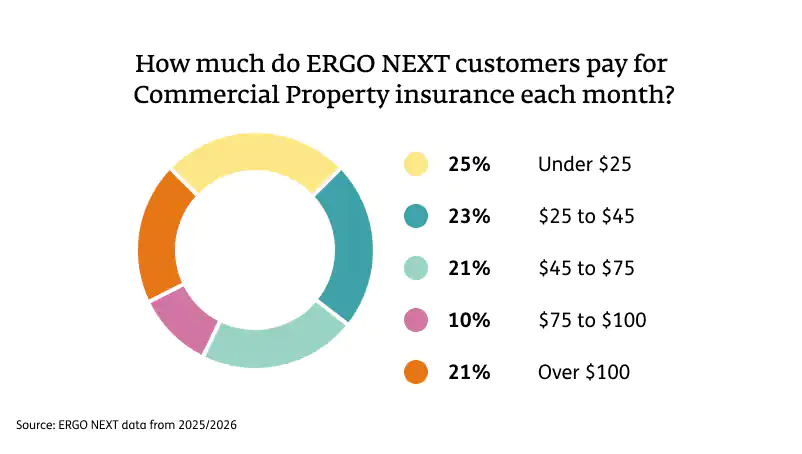
How much is low-cost Commercial Property insurance?
Property insurance to cover commercial buildings for renters and owners, business personal property, and business income insurance starts at just $18 per month for some low-risk businesses.
At ERGO NEXT, our commercial property coverage includes:
- Business personal property coverage (also called BPP insurance), which could help cover the contents of your business space, such as equipment, inventory, furniture, flooring and fixtures.
- Building coverage, which could help protect the building structure itself, including things like HVAC systems, sprinklers systems or damage from a fallen tree.
- Business income insurance coverage, also called business interruption insurance, could help cover lost income if your business is forced to close for repairs after an unexpected covered event, such as a fire, natural disaster or vandalism.
Commercial property insurance coverage can usually help business owners with:
- Building structural damage
- Inventory damage
- Damaged fixtures
- Stolen business goods and gear
- Equipment breakdowns
- Business income interruptions
What’s the average cost of Commercial Property insurance by profession?
| Profession | Average cost of commercial property insurance per month 1 | Types of business risks |
|---|
| Insurance agents | $30 | Basic office equipment like computers and client records can be damaged or stolen |
| Business consultants | $30 | Laptops and minimal office equipment can be lost, stolen or damaged |
| Accountants | $35 | Computers and paper financial records can be damaged or lost |
| Photographers | $40 | Studio equipment, cameras and editing computers can be damaged, lost or stolen |
| Barbers | $55 | Shop tools and equipment can be damaged by fire or water |
| E-commerce | $60 | Stored inventory and shipping supplies can be at risk |
| Caterers | $65 | Cooking equipment and supplies get damaged or fail |
| Food trucks | $65 | Kitchen equipment can be damaged by fire or equipment failure |
| Personal trainers | $65 | In-studio fitness equipment can be damaged by covered events |
| Bakery | $75 | Ovens, mixers and kitchen equipment face fire and heat-related damage |
| Gyms and fitness studios | $75 | Large, high-use equipment can be damaged with frequent daily use |
| Retail | $80 | Inventory, displays and POS systems can be damaged or stolen in-store |
| General contractors | $85 | Stored tools and expensive equipment can be damaged or stolen |
| Daycares | $90 | Furniture, fixtures and indoor spaces can be damaged by water leaks, flooding or burst pipes |
| Landscapers | $90 | Large mowers or machinery can be damaged by fire, weather or theft |
| Property management | $95 | Office equipment, records and building systems across multiple properties can be damaged by fire, water or large-scale events |
| Coffee shops | $100 | High-value espresso machines, refrigeration, inventory and fixtures face fire, water and equipment failure risks |
| Auto repair | $115 | Expensive machinery, vehicle lifts and shop equipment face fire, electrical and severe equipment damage risks |
| Restaurants | $150 | Kitchen equipment, inventory and fixtures face fire and high-use damage risks |
| Grocery stores | $155 | Large inventory and refrigeration systems face spoilage, theft and equipment failure |
Source: ERGO NEXT Insurance cost data, April 2026
How insurance companies calculate Commercial Property insurance cost
What your business will spend on the cost of commercial property insurance depends on several factors, including:
1. Your type of business or industry
Your business type is one of the biggest factors in commercial property insurance cost.
Lower-risk businesses, like consultants or florists, may pay less because they rely on simpler equipment and have fewer property-related risks.
Businesses with inventory, specialized equipment or high daily use — like retail stores or restaurants — may pay more due to increased risk of damage or loss.
In general, the more your business depends on physical property, the higher your insurance cost may be.
2. Your business location
Your business location can directly impact your commercial building insurance cost. Businesses in dense, high-traffic areas may pay more due to higher property values, increased theft risk and greater exposure to damages.
Insurers may also consider your building’s age, condition and construction type, along with nearby businesses. For example, if your business is located next to a restaurant or auto repair shop, that could increase your fire-related risks.
Local weather patterns, crime rates and foot traffic can also affect your premium, since these factors influence how likely your property is to be damaged or require repairs.
3. Your property condition and maintenance
The condition and maintenance of your building, storefront, warehouse or workspace can impact your commercial property insurance cost. Well-maintained buildings, updated systems and regular inspections may help reduce your risk of damages. Older or poorly maintained properties may be more likely to experience issues like leaks or electrical problems, which can increase premiums.
4. Your claims history
Your history of insurance claims could impact your insurance premium. If you’ve filed claims in the past, insurers may see your business as higher risk and make adjustments to your premium.
5. How you set your insurance coverage limits
Your coverage limits also play a key role in your commercial property insurance cost. Higher limits can provide more financial protection, but they can also increase your monthly cost for property insurance.
Note that these are just a few common factors that insurance companies consider when they calculate the cost of commercial property insurance for your business. Insurers may also take other external factors into account, such as economic conditions and market trends.