In general, the greater the financial impact of a potential mistake, the higher your premium may be. That’s why professions tied to large contracts, regulatory requirements or safety risks often carry higher insurance costs.
What’s the average cost of Professional Liability insurance by profession?
| Profession |
Average cost for professional liability insurance per month1
| Types of business risks |
|---|
| Accountants | $40 | Tax filing errors, incorrect financial advice, missed deadlines |
| Architects | $80 | Design flaws, code compliance issues, project delays |
| Business consultants | $60 | Missed ROI expectations, strategy errors |
| Engineers | $100 | Design errors, system failures, performance issues |
| IT consultants | $90 | System failures, data loss, implementation errors |
| Real estate agents | $70 | Misrepresentation, missed disclosures, contract disputes |
| Retail stores | $55 | Incorrect product advice, service errors, fulfillment mistakes |
| Social media consultants | $60 | Campaign errors, brand damage, missed performance targets |
| Software developers | $90 | Bugs or defects, system downtime, failed integrations |
| Travel agents | $50 | Booking errors, missed reservations, incorrect travel details |
| Videographers | $75 | Missed footage, delivery delays, contract disputes |
How much is the median cost of Professional Liability insurance?
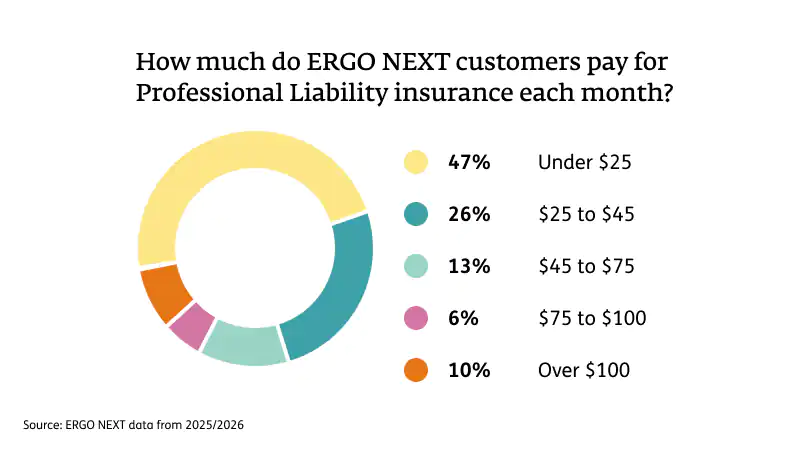
The median cost for a professional liability policy is $25 at ERGO NEXT. The median represents the middle point — half of our customers pay less, and half pay more.
For many small business owners, this can be a more realistic estimate than a starting price. It gives you a better sense of what businesses like yours may actually pay for coverage.
What factors influence Professional Liability insurance cost?
The cost of liability coverage for your small business depends on several factors. Insurance companies calculate your professional liability insurance rates by considering some of the following risk factors:
1. How your type of business is classified
Insurance companies usually use the North American Industry Classification System (NAICS) to put your business into a specific risk category. These NAICS entities help set a baseline for professional liability insurance costs based on how often people in similar jobs face claims.
The greater the financial loss of potential professional mistakes, the higher the risk in your profession. And in insurance, higher risk usually means a higher cost for coverage.
For example, a yoga instructor carries a different NAICS classification code than a structural engineer. It’s more likely that a mistake in building design may have higher financial stakes than a mistake in a yoga flow. Therefore, an engineer may see higher insurance costs.
2. Client or contract requirements
Client contractual obligations may dictate your professional liability coverage cost. If a client requires proof of insurance (also called a certificate of insurance, or COI) that states a specific coverage limit, you may need to spend more to meet their requirements before you start a project.
3. The number of employees you have
For example: monthly costs for coverage for a freelance or sole proprietor IT consultant are likely going to be less than if you run a firm of 10 employees.
4. The location where you work
Different states have rules and regulations around business insurance requirements. And in general, the more populous the area where you work, it’s more likely your insurance rates will be higher. A small business owner in a big city is more likely to pay more for insurance than a similar business in a small town.
5. Your insurance claims history
If you’ve had a covered claim in the past, insurers may see you as higher risk. Insurance companies could adjust your rate based on how likely they think it is that those events will happen again.
6. The limits and deductibles you choose
While higher coverage limits (the maximum amount an insurer will pay on a claim) on your professional liability insurance can offer more peace of mind, choosing more financial protection usually means an increase in your monthly or annual cost premium.
On the flip side, choosing a higher deductible (your out-of-pocket costs after a covered event before the insurance policy kicks in) for your professional liability insurance policy could help lower your monthly rate. If you do choose a higher deductible, you can expect to cover more costs on your own if you have to file a claim.
7. Your years of experience in your profession
The number of years you’ve been in business in your industry can impact your insurance rate. Seasoned professionals often pay less than newcomers to an industry.
Note: These are only a few common factors that can affect your costs. Insurance providers often take into account many other factors, including external economic conditions and market trends. In addition, it’s important to provide accurate information about your business when you get a professional liability insurance quote. This can help ensure you get the right coverage and avoid delays if you need to process a claim.