What is a Workers’ Compensation audit?

Workers’ comp audits help make sure you only pay for the coverage that you need. Here’s how they work.

Siva Mohan
NEXT Product Manager
Published Jul 14, 2026
Close-up of person working on laptop computer.

A workers’ compensation audit is a review of your payroll and employee job classifications at the end of your policy term. It helps make sure your workers’ comp premium reflects what actually happened in your business during the year.

Since the cost of your workers’ comp insurance is based on an estimate, most states require a workers’ compensation audit each year to make a final review based on your actual payroll and employee data.

Here’s everything you need to know about how workers’ comp audits work, what to expect and how to prepare.

What happens during a Workers’ Comp audit?

A workers’ compensation audit usually happens after your policy term ends. Sometimes a workers’ comp premium audit can also be triggered mid-year if your business experiences significant changes like a change in payroll, a sudden growth in headcount or a shift to higher-risk work.

Your insurance company reviews your business’s actual payroll, job classifications and total number of employees to help confirm your premium matches your true level of risk.

Most audits take place in one of three ways:

  1. Online or virtual audit: You upload documents such as payroll reports, tax forms and subcontractor certificates to your insurance company.
  2. Mail or phone audit: You submit your records through email or mail, then discuss details over the phone.
  3. In-person audit: An auditor may visit your business if required by your state or if your operations are complex.

Most workers’ comp audits follow a similar process, although requirements can vary by state and insurer. For instance, an employer-education guide from the California State Compensation Insurance Fund says audits are often conducted virtually or on-site. The guide notes that documents like payroll reports, tax forms, time cards, cash disbursements and cash payment records may be required.

Once your information is reviewed, your insurer compares your actual payroll data to the estimates you provided at the start of the policy. 

  • If your payroll was lower than expected, you may receive a refund or credit. 
  • If your payroll was higher than expected, your premium might increase to reflect the changes.

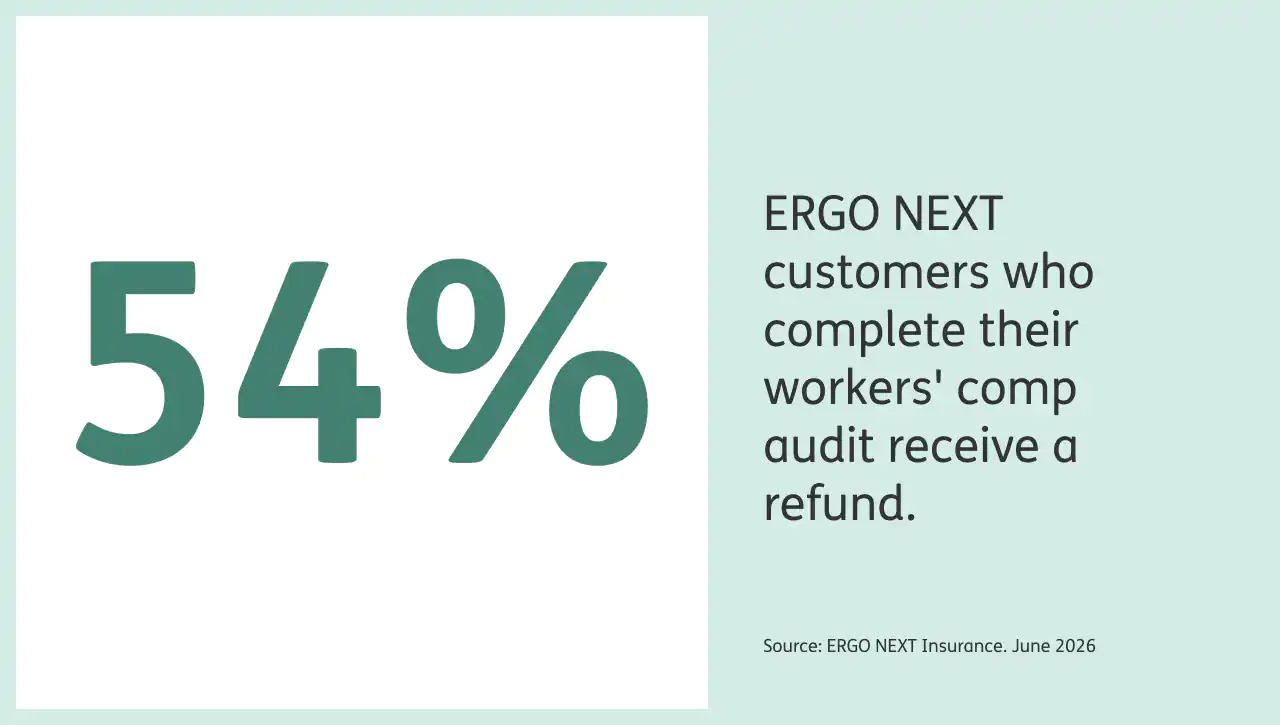
We’ve found that about a third of ERGO NEXT policyholders end up performing different work or reporting different payroll than expected. And about 54% of our workers’ comp policyholders who complete their audit end up receiving a refund.

How does a Workers’ Comp audit work?

To complete your workers’ comp insurance audit with ERGO NEXT, follow these three steps.

1. Log in to your account

ERGO NEXT will send you a reminder email when it’s time to conduct your audit. 

Once you’ve been notified, log in to your customer account and follow the prompts to verify current payroll details for you, your employees, subcontractors and partners from your payroll and tax documents.

2. Email your documentation

After you complete the questions online, email copies of your documents to us at wc_auditors@next-insurance.com. Please include all necessary documentation as provided above in our workers’ compensation audit checklist. 

Note that you should already have certificates of insurance for all subcontractors who worked for you to verify their own workers’ compensation insurance. 

We only ask for COIs for subcontractors who were marked as insured in the audit questionnaire. If your subcontractors don’t have their own workers’ comp insurance, their compensation may be included in your payroll.

3. Wait for your audit review and results

ERGO NEXT’s auditors will verify the information you provide and determine whether a premium adjustment or refund is needed.

You should receive an audit summary within about a week. The results are usually one of three scenarios:

  1. If the payroll estimate was the same as your actual payroll, no further action is necessary.
  2. If the actual payroll is less than the estimate, your insurance costs decrease and we’ll issue a refund to the credit card we have on file within 30 days of issuing the audit summary.
  3. If the actual payroll is greater than the estimate, we will change your policy to help confirm you’re adequately covered for the year. You will be notified of the correct premium for the policy, and your business will have 30 days to review the additional cost for coverage. At the end of 30 days, we’ll charge the credit card we have on file for your account.

No matter the outcome, 30 days after the completion of the audit you’ll receive an email notification that the audit is complete. 

Log in to your customer account to see updates on adjustments and refunds. We’ll also provide updated policy documents for your records.

Three tips to simplify your annual Workers’ Compensation insurance audit

If you already have workers’ comp with ERGO NEXT, there are a few ways to make your workers’ comp audit even smoother:

  1. Keep your payroll estimate current. You don’t have to wait for audit season — you can  log in to your online ERGO NEXT account anytime to update payroll or employee information during your policy term. This can help keep your premium accurate and up to date.
  2. Consider ERGO NEXT Pay-As-You-Go workers’ comp. With pay-as-you-go (PayGo) workers’ compensation, available only through our network of over 100 partners, including Intuit’s Quickbooks, Square, Gusto, Toast, Patriot, Homebase and more, your premium automatically adjusts based on your real payroll instead of estimates. That means fewer surprises during your annual audit — and payments that stay in sync with your business throughout the year.
  3. Review your audit summary early. After your audit is complete, review your summary as soon as it arrives. If you have any questions about premium adjustments or next steps, contact our support team at (855) 222-5919 within 30 days of getting your audit summary email.

Our team is here to help you understand your results and resolve any issues before any charges or refunds are applied.

Why does your Workers’ Comp premium need to be audited?

When you buy workers’ comp coverage, you estimate your annual payroll and the primary type of work your employees will do during the policy period. Your insurance company uses that estimate to set your premium (the initial cost you pay) and coverage level.

But a lot can change in a year:

  • Your number of employees can grow or shrink
  • The type of work your employees do can change
  • The hours spent on each task can ebb and flow
  • Raises or pay cuts can alter salaries or wages

Since these changes are common for most businesses, your reality can drift from your original coverage estimate. 

A workers’ comp audit reconciles your estimate with what actually happened, using your real payroll data and class codes (the insurance industry’s job classifications that tie premiums to risk). This can help ensure your coverage matches your business and, if it doesn’t, then your premium may adjust up or down as needed. 

Even if your business closes or your policy is canceled before the term ends, you’ll still need to complete the audit to finalize your coverage record. That helps ensure any past claims may still be processed correctly.

What happens if you don’t do a Workers’ Comp audit?

As any business owner knows, calendars get crunched, to-do lists grow long and tasks can slip through the cracks. But regardless of how busy you are, workers’ comp audits are a required part of keeping your coverage accurate. 

If you don’t complete your workers’ comp audit, here’s what could happen:

  • A non-compliance charge could be added to your policy. In some states, insurers may charge an additional non-compliance fee or estimate your premium based on higher payroll.
  • Your active workers’ compensation policy could be canceled. This could leave your business potentially out of compliance with state laws.
  • Your business could be reported as non-compliant to relevant state agencies. That can make it harder to secure workers’ comp coverage later or delay new policy approvals.

Depending on your state and insurer, workers’ comp audit penalties may include estimated payroll charges, additional premium assessments or policy cancellation.

Complete your workers’ comp audit on time to keep your policy in good standing and help ensure your business is properly protected.

Are Workers’ Compensation audit requirements different by state?

Yes. Workers’ compensation audit requirements can vary by state. While most audits review payroll records, employee classifications and subcontractor documentation, some states impose additional audit requirements for certain industries or business sizes.

For example, Florida law requires annual audits for many construction businesses and requires physical on-site audits for construction employers with an estimated annual workers’ compensation premium of $10,000 or more. Florida also requires employers to provide records needed to complete the audit

When in doubt, provide more documentation rather than less. Your auditor will tell you what they need.

Workers’ Compensation audit checklist

Partial or incomplete records are one of the most common reasons audits can take longer than expected or result in estimated charges. Use this workers’ comp checklist to get organized before your annual workers’ comp audit. Having these documents ready in advance can speed up the process and help you avoid billing surprises.

Payroll documents

  • Payroll summaries or reports from your payroll system
  • Federal W-2s and W-3
  • Federal 1099s for any contractors or freelancers you paid
  • Federal Employer’s Annual and Quarterly Tax Returns (Form 944 and 941)
  • Federal Employer’s Annual Unemployment (FUTA) Tax Return (Form 940)
  • Federal Profit and Loss From Business Schedule C (Form 1040) if applicable

Make sure your payroll records include all eligible compensation types: wages, salaries, commissions, bonuses and overtime pay. 

Employee and classification records

  • Job descriptions or titles for each employee
  • Documentation of any changes to employee roles or duties during the policy term
  • Records of any new hires or departures during the year

Subcontractor records

  • Certificates of insurance (COIs) for all subcontractors who worked for you during the policy term

State requirements can vary, so your insurer may ask for additional documentation depending on where your business operates.

How ERGO NEXT helps protect your business

ERGO NEXT makes it fast, easy and affordable to protect your small business — and you can do it all online.

We’ll ask a few questions about your business and give you a quote. You can select your coverage options and buy your policy in about 10 minutes. Share your certificate of insurance at no extra cost, and you can access your policy 24/7 via web or mobile app.

If you have questions, our licensed, U.S.-based insurance professionals are available to help.

Start a free quote with ERGO NEXT.

Workers' Comp audit FAQ

Get answers to the most common questions about workers' compensation audits for small business owners.

How far back does a Workers' Compensation audit go?

A workers' comp audit typically applies to the most recent policy term, usually 12 months. It looks at your actual payroll and job classifications during that specific period, not previous years. However, if a prior audit was incomplete or disputed, your insurer may need to revisit earlier records to resolve any outstanding discrepancies.

What payroll is included in a Workers' Compensation audit?

Most types of employee compensation are included in a workers' comp audit, including wages, salaries, commissions, bonuses and overtime pay. Payments to subcontractors may also be included unless your subcontractors can provide their own certificate of insurance showing they carry their own workers' comp coverage. Your insurer will typically ask for payroll summaries, W-2s, 1099s, quarterly tax filings and job descriptions to verify payroll information.

What could trigger a Workers' Comp audit?

Most workers' comp audits happen annually at the end of your policy term, but a mid-year audit can be triggered by significant changes to your business — such as a large increase in payroll, adding new employees, taking on higher-risk work or substantial changes to your job classifications. If you keep your payroll information updated with your insurer throughout the year, you can help reduce the likelihood of a mid-year audit.

What happens if my actual payroll is higher than my original estimate?

If your actual payroll during the policy period was higher than your original estimate, your insurer will adjust your premium upward to reflect the additional coverage your business needed. With ERGO NEXT, you'll be notified of the correct premium and given 30 days to review the additional cost before any charge is applied. This is why keeping your payroll estimate current throughout the year — rather than waiting for the audit — is important to help avoid larger adjustments at the end of the term.

Can I get a refund from a Workers' Comp audit?

If your actual payroll was lower than your original estimate, you may receive a refund or premium credit after the audit. About 54% of ERGO NEXT workers' comp policyholders receive a refund after completing their annual audit. With ERGO NEXT, refunds are issued to the credit card on file within 30 days of sending the audit summary.
Siva Mohan
About the author

Siva Mohan has 17+ years of experience within the insurance industry. As a Product Manager at NEXT, Siva is responsible for developing and explaining insurance products for small business owners, with a focus on Commercial Insurance, Workers’ Comp and underwriting.

Business insurance has never been easier

Customized business insurance to protect you and your clients

Fast

Get covered in 10 minutes and you can save up to 25% in discounts*

Flexible

Coverage that grows with you and easy monthly payments

Convenient

Do it all 100% online or talk to a licensed U.S.-based advisor

What we cover
Chat with Us

Mon – Fri | 8 a.m. – 5 p.m. CT

Facebook
Instagram
Tiktok
Twitter
Linkedin
Youtube
© 2026 Next Insurance, Inc. 975 California Ave, Palo Alto, CA 94304, United States
Better Business Bureau
NEXT is part of the ERGO Group, a Munich Re company.

Issuance of coverage is subject to underwriting. Not available in all states. Please see the policy for full terms, conditions and exclusions. Coverage examples are for illustrative purposes only. Your policy documents govern, terms and exclusions apply. Coverage is dependent on actual facts and circumstances giving rise to a claim. Next Insurance, Inc. and/or its affiliates is an insurance agency licensed to sell certain insurance products and may receive compensation from insurance companies for such sales. Policy obligations are the sole responsibility of the issuing insurance company. Refer to Legal Notices section for additional information.

* To the extent permitted by law, applicants are individually underwritten, not all applicants may qualify. Individual rates and savings vary and are subject to change. Discounts and savings are available where state laws and regulations allow, and may vary by state. Certain discounts and policy start times apply to specific coverages only.

** Coverage examples are for illustrative purposes only. Your policy documents govern, terms and exclusions apply. Coverage is dependent on actual facts and circumstances giving rise to a claim.

Any starting prices or premiums represented before an actual customer quote are not guaranteed and are representations of existing premiums of active policies as of April 1, 2026. To the extent permitted by law, applicants are individually underwritten, not all applicants may qualify. Individual rates and savings vary and are subject to change. Discounts and savings are available where state laws and regulations allow, and may vary by state. Certain discounts apply to specific coverages only.